How to Create a Signature Hair Care Collection for Your Brand
A successful hair care brand is about more than putting your logo on a bottle. It is about creating a product collection that reflects your expertise, serves a specific customer and delivers a consistent experience from the first wash to the final styling step. Whether you are a salon owner, an entrepreneur or an established business expanding into beauty, a signature hair care collection can help turn your vision into a recognisable brand.
Private label manufacturing makes it possible to build a product line under your own brand without establishing a manufacturing facility yourself. You can explore product categories, select the range that suits your audience, develop your visual identity and prepare your products for market with the right manufacturing partner.
The key is to start with a clear concept rather than choosing products at random. This guide explains how to identify your audience, plan your collection, select complementary products, create a consistent brand identity and prepare your hair care range for launch.
1. Start With a Clear Brand Concept
Before choosing bottles, formulas or product names, decide what you want your hair care brand to represent. A clear concept gives every decision a purpose. It helps you determine which products belong in the collection, how the packaging should look and what customers should remember about your brand.
Your concept might be built around professional salon expertise, everyday hair maintenance, textured hair styling, simplified routines or products designed for a particular customer lifestyle. You do not need to serve everyone. In fact, a focused concept can make your brand easier to understand and communicate.
Think about the products your intended customers already use, the frustrations they experience and the routines they want to improve. A salon professional may see opportunities for a styling range that supports the services they provide. An entrepreneur may identify demand for a simple wash-day collection. A content creator may want products that reflect their personal approach to hair styling.
The goal is to create a connection between the customer, the products and the brand story. A clear concept should be specific enough to guide your decisions but flexible enough to support future growth.
Start with three questions: Who is the collection for? What need will it address? What should customers associate with your brand after using the products?
2. Define Your Ideal Customer
Your ideal customer influences almost every part of your product range. Different customers have different expectations around styling, convenience, packaging, price and the number of products they want in their routine.
Instead of describing your audience simply as people who care about their hair, create a more useful picture of the people you want to reach.
Salon owners and professional stylists
Salon professionals can build a hair care brand around the expertise they already offer. They understand their clients' routines, regularly discuss styling needs and can introduce products that complement their services. A professional range might include shampoo, conditioner, leave-in products and finishing sprays that customers can use between appointments.
Entrepreneurs launching a beauty brand
An entrepreneur may want to enter the hair care market with a distinctive visual identity and a carefully selected collection. This audience may benefit from a clear product strategy, a manageable initial range and packaging that looks consistent across every item.
Customers who love styling and self-expression
A styling-focused brand can serve customers who enjoy experimenting with their look. Products such as texture sprays, styling clay, texture powder, mousse and hairspray can form the foundation of a collection built around creative styling.
Customers who want a straightforward routine
Some customers prefer a small number of products that fit easily into their daily lives. A focused cleansing and conditioning range, supported by one or two complementary products, can make the collection easier to navigate.
Choose the audience that best matches your knowledge, interests and access to customers. A strong understanding of a smaller audience can be more useful than a broad brand concept with no clear point of difference.
3. Build the Collection Around a Customer Need
Once you know who you are serving, decide what role your product range will play in their routine. A coherent collection has a reason for each product to exist. It should help customers move from one step to the next without making the range unnecessarily complicated.
For example, a basic wash-day collection may focus on cleansing and conditioning. A styling collection may help customers create texture, shape and hold. A salon-led collection may combine essential cleansing products with the finishing products used during appointments.
You can also build around a particular customer experience, such as simplifying the daily routine or making salon-inspired styling more accessible at home. The important point is to connect the product choices to the needs of the audience rather than selecting items solely because they are popular.
Consider mapping your range by function. This makes it easier to spot gaps and unnecessary overlap before you invest in packaging and inventory.
| Product role | Possible products | Purpose in the range |
|---|---|---|
| Cleanse | Shampoo | Provides the cleansing step in the routine. |
| Condition | Conditioner | Complements the wash step and rounds out the core routine. |
| Prepare | Leave-in product or detangler | Supports the preparation and styling process. |
| Style | Curl cream, styling clay or texture powder | Offers options for different styling preferences. |
| Finish | Hairspray, shine spray or texture spray | Completes the styling routine with a distinct product function. |
These are examples of possible roles, not a requirement to launch every product. Select the items that best support your concept and can be explained clearly to your customers.
4. Choose Your Hero Products
A hero product is one of the central items that helps customers recognise your brand. It may address a particularly important need, fit naturally into a common routine or express the brand's identity especially well.
You do not need to invent an entirely new product category to create a hero product. Your opportunity may come from the customer you serve, the way you present the product, the experience you create or the role it plays within your collection.
A salon owner might choose a signature styling spray that complements the services offered in the salon. A brand focused on everyday hair care may lead with its shampoo and conditioner pairing. A styling-led collection might use a texture product as the centrepiece of the range.
When selecting a potential hero product, consider whether it is easy to explain, relevant to your audience and suitable for the brand you want to build. Think about how it will appear in photography, how it will be demonstrated and how it can connect with other products in the collection.
Your hero product should not exist in isolation. Build a plan for how it can introduce customers to the wider range. Complementary products can provide opportunities for bundles, routines and repeat purchases without forcing customers to buy items they do not need.
5. Decide How Many Products to Launch With
It can be tempting to launch a large collection immediately. A wide range may look impressive, but every additional product introduces more decisions around packaging, labels, inventory, product education, photography and marketing.
A focused launch can help you learn which products customers respond to before expanding the collection. It also makes it easier to create a consistent visual identity and explain the purpose of each item.
For example, a new wash-day brand might begin with shampoo and conditioner, then introduce a leave-in product if it fits the customer's needs. A styling brand might start with a small group of products that cover different functions, such as hold, texture and finishing.
There is no universal ideal number of products. Your launch size should reflect your budget, your supplier's minimum order quantities, the demand you can reasonably expect and the number of products you can actively promote.
Consider the difference between a complete routine and a large catalogue. A compact range can still feel intentional when each product has a clear role and the collection works together.
6. Choose Products That Complement Each Other
A well-planned hair care collection feels connected. The products may serve different purposes, but they should share a common customer, point of view and visual identity.
One useful approach is to organise your range into product families. You might have a cleansing family, a conditioning family and a styling family. Each family serves a distinct role while remaining part of the same brand.
Build a wash-day pairing
Shampoo and conditioner can form a natural starting point for a routine-focused range. Presenting them as a pair makes the collection easy to understand and provides a straightforward foundation for product bundles.
Build a styling system
A styling collection may combine products that perform different jobs. A mousse may serve a different role from a firm-hold hairspray, while a texture spray and a texture powder can offer distinct options for customers who want to experiment with their styling.
Add products with a clear purpose
Before adding another item, ask what it contributes to the collection. Does it serve a new need, complement a hero product or make the routine more convenient? If its purpose overlaps heavily with another item, decide whether both are necessary at launch.
Product naming can help customers understand these differences. Use clear, concise names that communicate the product's role and fit your brand identity. Avoid relying on vague names that make it difficult to distinguish one item from another.
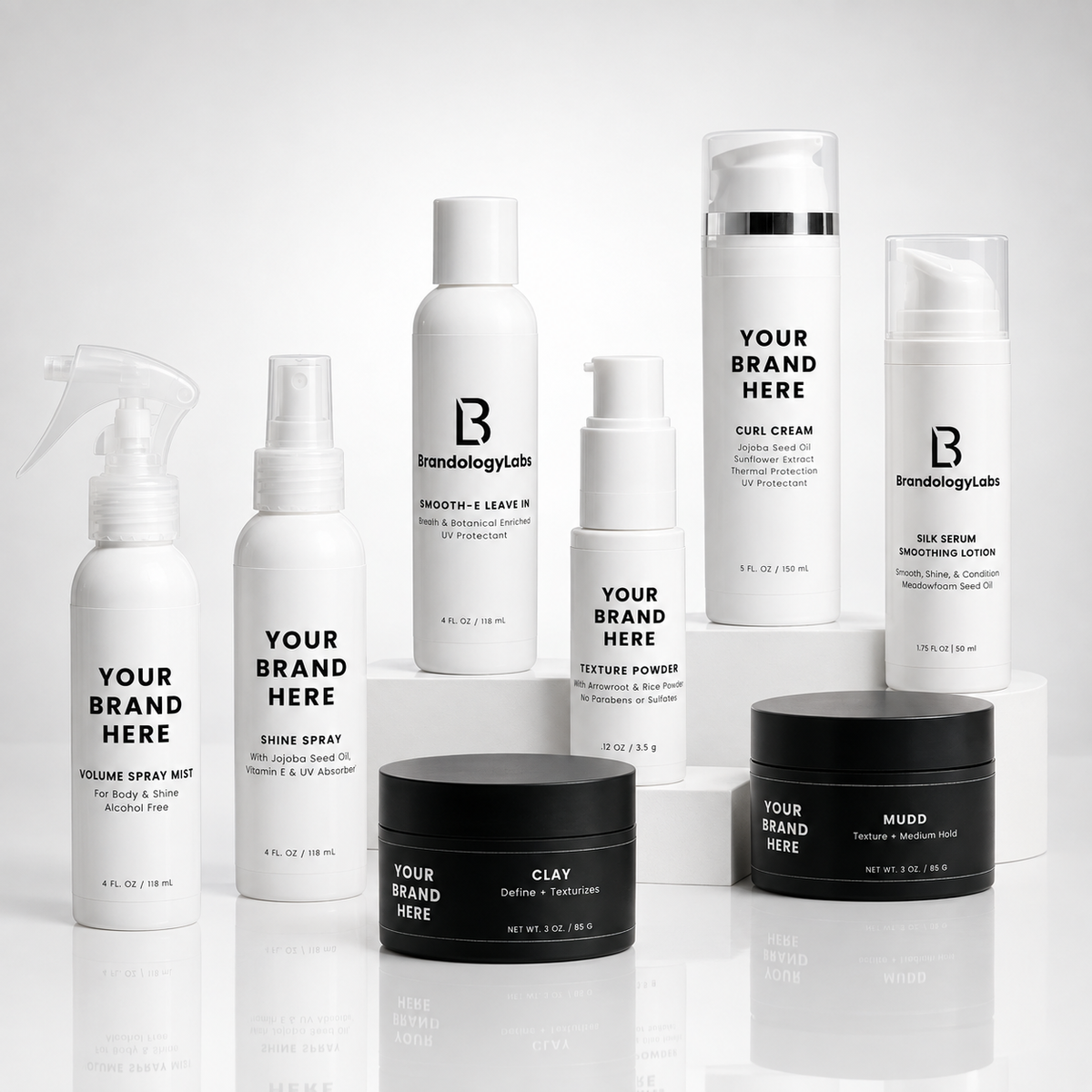
Explore the Brandology Labs hair care collection for examples of product categories you could consider when planning your range.
7. Make Packaging Part of the Brand Experience
Packaging is often the first physical interaction a customer has with your brand. Before they try the formula, they see the bottle, read the label, handle the product and form an impression of the collection.
Your packaging should reflect the brand you want customers to recognise. A clean professional range may use restrained typography and a consistent colour palette. A bold styling collection may use stronger visual contrasts. A premium everyday range may use carefully chosen finishes and a simple, cohesive layout.
The objective is not to make every bottle look expensive. It is to make the complete collection look intentional and appropriate for the intended customer.
Keep the visual identity consistent
Choose a clear set of brand elements, including typography, colours, logo treatment and label layout. Apply those elements consistently across the range. Customers should be able to recognise that the products belong together even when the packaging sizes or formats differ.
Make labels easy to read
A label needs to balance brand presentation with practical product information. Make the product name legible and ensure that important information is organised clearly. Check the required labelling rules for the markets where you intend to sell, including ingredient declarations, directions, warnings and other applicable information.
Consider the complete product range
Review the products together rather than designing each label in isolation. Look at how the collection appears side by side, how the names differ and whether the packaging creates a clear hierarchy. Consistency helps the range look like one brand instead of a collection of unrelated products.
8. Develop Product Names That Customers Understand
Product names should help customers recognise what an item does and how it fits into the collection. Creative naming can make a brand memorable, but clarity remains important, particularly when customers are comparing several products for the first time.
One approach is to combine a straightforward product type with a distinctive range name. Another is to use a consistent naming structure across the entire collection. Either approach can work when the names remain easy to distinguish and are appropriate for the audience.
Avoid giving every product a completely different naming style. If one item has a technical name, another uses a playful phrase and another uses an unrelated luxury expression, the collection may feel disconnected.
You should also be careful with product claims. Names and descriptions should accurately reflect the product's purpose and evidence. Do not promise results that have not been substantiated or use wording that could mislead customers about what a formula can do.
Before finalising your names, check spelling, readability, availability and potential trademark conflicts in your intended markets. A consistent naming system can support product recognition as the range grows.
9. Work With a Private Label Manufacturer
A private label manufacturer can help you explore product options and bring your own branded collection to market. Choosing the right partner involves more than comparing a single unit price. You need to understand the products available, the manufacturing arrangements, packaging options and the process for preparing your order.
Begin with a clear brief that explains your brand concept, target customer, intended product range and preferred packaging direction. You do not need to have every detail finalised, but you should be able to explain what you want the collection to achieve.
Useful questions to ask a prospective manufacturing partner include:
- Which hair care product categories are available for private label?
- What minimum order quantities apply to each product?
- Which packaging formats and sizes can be considered?
- What artwork and label specifications are required?
- What is the expected production and delivery timeline?
- Which product documentation can be supplied?
- How are product changes, quality concerns and repeat orders handled?
- Which costs are included in the quoted price, and which are additional?
Ask for clear answers before making financial commitments. The details may vary by product and order, so avoid assuming that all items share the same quantities, lead times or packaging arrangements.
Your manufacturer should be able to explain the process and the information needed to move your project forward. Clear communication helps you make informed decisions about the range you want to launch.
10. Plan Your Pricing Before You Commit to the Range
Your collection needs to work as a business, not just as a visual concept. Before confirming the range, estimate the costs of manufacturing, packaging, freight, fulfilment and other expenses relevant to your sales model.
Research comparable products and decide where your brand should sit in the market. A salon-oriented product may have a different value proposition from an everyday product sold directly to consumers. Your price should reflect your audience, your product and the experience you offer.
Review each item separately. A shampoo, conditioner, mousse and styling spray may have different costs and package sizes, so the same retail multiplier may not suit every product.
If you plan to sell bundles, calculate the combined product costs and the effect of any discount. If you plan to sell through retailers, work backwards from the expected retail price to determine whether your wholesale price can support both your business and the retailer.
Also consider your initial order quantity. Ordering more stock may affect the unit price, but it increases the cash invested in inventory. Choose a quantity that makes sense for your budget and your ability to reach customers.
A clear pricing plan helps you decide whether to adjust the product mix, packaging, sales channel or launch size before you place an order.
11. Create a Consistent Marketing Strategy
Once your product range and visual identity are taking shape, plan how you will introduce the collection to customers. Marketing should explain the purpose of the range and show how each product fits into the customer's routine.
You do not need to rely on generic product photographs and broad claims. Build content around the actual reasons customers might choose your products. Show the packaging clearly, explain the function of each item and demonstrate how the products can be incorporated into a routine.
Use product education
Educational content can help customers understand the difference between products and decide which ones are relevant to them. Explain how a styling product differs from another item in your range, or show the order in which a routine can be used when that order is appropriate for the products.
Show the collection together
Group photography helps communicate that your products belong to one brand. Use consistent lighting, backgrounds and composition so customers can see the relationship between individual items. Keep the packaging readable and avoid visual clutter that competes with the products.
Use the channels where your customers spend time
Depending on your audience, your marketing may include social media, a Shopify store, email, salon demonstrations or partnerships with relevant creators. Choose channels you can maintain consistently rather than attempting to be everywhere at once.
Every channel should reinforce the same brand message. Product pages, labels, social content and customer communications should describe the collection consistently and accurately.
12. Prepare Your Product Pages for Launch
Your online store should make it easy for customers to understand and compare the products in your collection. A product page is more than a photograph and a price. It should provide enough clear information for customers to decide whether the item suits their needs.
Consider including the following elements on each product page:
- A clear product title: Use a name that is easy to recognise and understand.
- High-quality images: Show the packaging, product details and overall appearance clearly.
- A concise description: Explain the product's purpose and intended customer.
- Directions for use: Provide clear instructions appropriate to the product.
- Relevant product details: Include size, format and other useful information.
- Accurate claims: Ensure that performance and ingredient claims are supported and appropriate.
- Related products: Help customers discover complementary items when it makes sense.
Consistent product pages can make even a small collection feel professionally organised. They also give you a useful foundation for search visibility and future content marketing.
Use descriptive page titles and meta descriptions, link related products and articles where relevant, and make sure your store works well on mobile devices. SEO takes time, so treat it as part of an ongoing content and site improvement strategy rather than a one-time task.
13. Launch, Learn and Improve the Collection
Launching your collection is the beginning of the learning process. Customer responses can help you understand which products are easiest to sell, which descriptions need improvement and where customers need more guidance.
Track sales by product rather than only looking at total revenue. A product that attracts attention may not be the item that generates the most repeat purchases. Likewise, a product that sells less frequently may still play an important role in completing a routine or increasing the value of a bundle.
Pay attention to customer questions, product reviews, repeat orders and common reasons for hesitation. These signals can reveal opportunities to improve product education, refine your range or adjust the way you present the collection.
Avoid expanding the range simply because you want to offer more products. Use evidence to determine whether a new item addresses a real customer need and whether your business is ready to support the additional inventory and marketing requirements.
As you gain experience, you may decide to introduce new products, refine packaging, develop bundles or create a second collection for a different audience. Each decision should build on what you have learned from the products you already sell.
14. Your Signature Hair Care Collection Checklist
Before moving from an idea to a manufacturing order, use this checklist to review the key decisions behind your collection.
- I have defined the audience my hair care brand is designed to serve.
- I can explain the customer need my collection addresses.
- Every product has a clear purpose within the range.
- I have identified the hero product or core product pairing.
- The initial product count is realistic for my budget and launch plan.
- The packaging and naming system create a consistent brand identity.
- I have checked product information and applicable labelling requirements.
- I understand the manufacturer's quantities, costs and lead times.
- I have estimated product costs and reviewed my intended retail pricing.
- I have a plan for photography, product pages and marketing.
- I know how I will collect customer feedback and measure performance.
If some decisions are still open, use them to guide your next conversation with your manufacturing partner. A clear brief and a focused collection make it easier to evaluate your options and plan a launch that reflects your brand's goals.
Frequently Asked Questions
1. What is a private label hair care collection?
A private label hair care collection is a range of hair care products sold under your own brand and produced through a manufacturing partner. Depending on the manufacturer's offering, you can select product categories and packaging options that fit your brand concept and intended customers.
2. How many products should I launch with?
There is no single ideal number. Choose a launch range that suits your budget, customer needs, manufacturing quantities and ability to market each product. A focused collection with clear product roles can be easier to manage than a large range launched without validated demand.
3. Can salon owners create their own hair care brand?
Yes. Salon owners can explore private label products that complement their services and customer routines. A salon's existing expertise and customer relationships can help inform product selection, brand positioning and marketing.
4. How do I choose the right products for my brand?
Start with your target customer and the need you want to address. Select products that support that need, complement one another and fit your budget. Consider how each item will be positioned, packaged and explained to customers.
5. Why is packaging important for a hair care brand?
Packaging influences product recognition, readability and the customer's first impression. A consistent packaging system helps the range look cohesive and communicates the brand's identity. Labels must also provide the information required for the markets where the products will be sold.
6. How do I choose a private label hair care manufacturer?
Review the available product categories, minimum order quantities, packaging options, documentation, costs and lead times. Ask how the manufacturing process works and confirm what is included in the quotation before committing to an order.
7. Should all products in my collection have the same packaging?
The packaging does not need to be identical, but the collection should share consistent brand elements such as typography, colour, logo placement and label structure. Packaging choices should also suit the product format and practical requirements.
8. How can I make my hair care brand stand out?
Develop a clear customer focus, create a coherent product range, use consistent branding and communicate the purpose of each product clearly. Your distinction may come from the audience you serve, your professional expertise, your product selection or the experience you build around the collection.
9. Can I expand my hair care collection after launch?
Yes. Many brands start with a focused range and add products as they learn more about customer demand. Use sales data and customer feedback to identify meaningful additions, and make sure you can support the costs and marketing requirements of each new product.
10. What should I do first when starting my own hair care brand?
Define your target customer, identify the need your brand will serve and outline the first products you want to offer. Then research manufacturing options, packaging, order quantities and pricing. A clear concept will help guide the decisions that follow.
Turn Your Hair Care Vision Into Your Own Brand
Your expertise, ideas and understanding of your customers can be the starting point for a distinctive hair care collection. With a clear product concept, considered packaging and the right manufacturing partner, you can begin building a range that reflects your vision.
Brandology Labs offers private label opportunities across multiple beauty categories, helping businesses explore products they can bring to market under their own brands.
Explore our hair care range or get in touch to discuss your product ideas and launch requirements.