How to Start a Private Label Hair Care Brand: From Product Selection to Launch
Launching a hair care brand gives you the opportunity to turn a business idea into a product range customers can recognise, trust and make part of their daily routines. Whether you are a salon owner looking to introduce your own products, an entrepreneur entering the beauty market or an established business expanding its offering, private label manufacturing can provide a practical route to building your brand.
Instead of developing every product and manufacturing process independently, private label allows you to work with a manufacturer to source suitable products and present them under your own brand identity. Your decisions around product selection, packaging, positioning and marketing help shape how customers experience your range.
However, launching successfully involves more than choosing a shampoo bottle and designing a label. You need to understand your customer, select products with a clear purpose, plan your budget and create a consistent brand experience.
This guide walks through the key steps involved in starting a private label hair care brand, from defining your market and selecting products to preparing your packaging and planning your launch.
1. Define Your Hair Care Brand Before Choosing Products
One of the first decisions to make is what your hair care brand will stand for. A clear brand direction makes it easier to select products, create packaging and communicate with the customers you want to reach.
The hair care market includes products for different routines, preferences, hair textures and styling needs. Trying to appeal to everyone from the beginning can make your brand difficult to distinguish from existing options.
Identify your ideal customer
Start by describing the person or business you want to serve. Think about their needs, buying habits, budget and reasons for choosing one hair care product over another.
Your audience could include salon professionals who want retail products to offer clients, consumers looking for straightforward everyday essentials, customers interested in styling products or businesses serving particular hair care routines.
These audiences have different priorities. A salon owner may value products that fit professional services and support retail sales. A direct-to-consumer brand may focus more heavily on product discovery, packaging appeal and a simple online shopping experience.
Choose a clear brand position
Your positioning describes the place you want your brand to occupy in the market. It helps explain why a customer should consider your products instead of another option.
For example, your brand might focus on professional-inspired styling essentials, simple daily hair care, salon retail products or a carefully curated range for a particular customer group.
Choose a direction that fits your knowledge, audience and business model. Avoid making broad promises that your products cannot substantiate. Product claims should be supported by appropriate evidence and reviewed for the markets where you intend to sell.
Research the competitive landscape
Look at brands already serving your target audience. Review their product ranges, packaging, prices, product descriptions, distribution channels and visual identities.
Pay attention to how they explain their products and what makes their ranges easy to understand. This research can reveal opportunities to create a more focused offer or communicate a familiar product category in a way that suits your audience.
The objective is not to copy another brand. It is to understand the market well enough to make deliberate choices about your own positioning.
Key takeaway: Before deciding which products to order, define who your brand serves, what your range will offer and why the products belong together.
2. Select the Right Products for Your First Collection
A new hair care brand does not need to launch with every product imaginable. A focused collection can be easier to finance, manage and market while you learn what your customers want.
Choose products according to your brand's purpose rather than selecting items simply because they are available.
Start with core hair care essentials
Shampoo and conditioner are familiar starting points for many hair care concepts. They can form the foundation of a daily routine and provide a clear way to introduce customers to your brand.
Depending on your target audience, you might explore products such as:
- Shampoo and conditioner.
- Detangling products.
- Leave-in hair care products.
- Styling creams and curl creams.
- Hair sprays with different hold levels.
- Texture sprays and texture powders.
- Hair polish and shine products.
- Products designed for specific styling routines.
Each product should have a defined role within your collection. A styling-focused brand, for example, may place more emphasis on hold, texture and finishing products, while a daily hair care brand may prioritise cleansing, conditioning and detangling.
Build a collection around a routine
Products are often easier to present when customers can understand how they fit together. Consider the steps in your target customer's routine and identify where your products could provide a coherent offering.
A simple collection might include a cleansing product, a conditioning product and a styling essential. A professional styling range might focus on products used to prepare, shape and finish a hairstyle.
This approach creates a logical foundation for product descriptions, website navigation, bundles and future marketing campaigns.
Prioritise products with a clear purpose
For every proposed product, ask what customer need it addresses, how it fits your positioning and whether you can explain its value clearly.
If two products serve nearly identical purposes, decide whether both are necessary for your first launch. Too many similar options can make purchasing decisions more complicated and increase the number of individual products you need to manage.
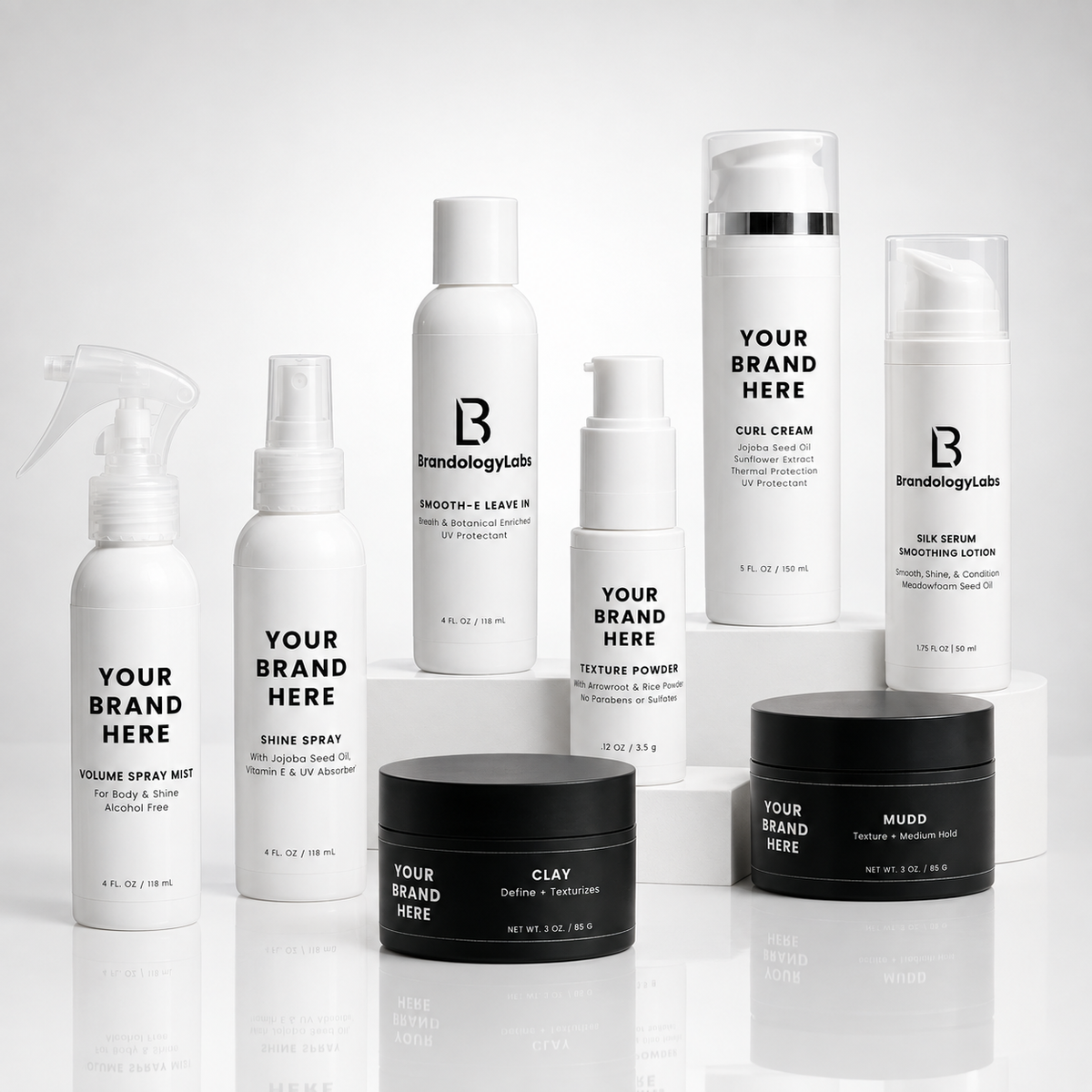
You can explore available product categories through the Brandology Labs hair care collection.
3. Understand How Private Label Manufacturing Works
Private label manufacturing allows businesses to sell products under their own brand. Depending on the manufacturer and arrangement, a business may select from available products and customise elements such as branding, labels and packaging.
This differs from building an entire manufacturing operation independently. You can concentrate on defining your range and developing the customer-facing parts of your business while working with a supplier on the product and production requirements.
Understand the available product options
Ask the manufacturer which products are available, what variations can be offered and which aspects of the product or packaging can be customised.
Not every product will offer the same choices. Available sizes, containers, dispensing systems, label formats and other options may differ by product.
Confirm what is included in the manufacturing arrangement rather than assuming every customisation is available as standard.
Clarify the difference between private label and custom formulation
Private label generally refers to selling a product under your own brand, often using an existing product or formulation offered by a manufacturer. Custom formulation involves developing or adapting a formula to meet specific requirements.
These routes can involve different costs, timelines, technical work and production requirements. If a distinctive formula is central to your business concept, ask the manufacturer what development options are available and how they affect the project.
Confirm responsibilities before production
Establish who is responsible for preparing label artwork, confirming product specifications, approving packaging and supplying required product information.
You should also clarify the quality documentation and product information available from the manufacturer, as well as any responsibilities that remain with your business when selling the finished products.
Clear communication at this stage helps reduce misunderstandings and gives you a better understanding of the work required before the products are ready to sell.
4. Create a Distinctive Brand Identity
Your brand identity is the visual and verbal system that makes your products recognisable. It includes your brand name, logo, typography, colour palette, packaging design, photography and the language used to describe your products.
A strong identity should communicate the positioning you established at the beginning of the project.
Choose a brand name that fits your direction
Your name should be appropriate for your intended audience and flexible enough to support the direction in which you want to grow.
Before committing, check the availability of the relevant domain names and social media handles. Investigate trademark availability in the markets where you intend to operate and obtain appropriate advice if necessary.
A name that is memorable and easy to use across packaging, a website and marketing materials can make it easier to build a consistent identity.
Develop a consistent visual system
Choose typography, colours, imagery and design elements that work together across your product range. Consistency helps customers recognise products as part of the same brand, even when the containers or product formats differ.
For example, a professional hair care brand might use restrained typography and a consistent label layout to create a cohesive collection. Another brand might use a more expressive visual style to suit its audience and positioning.
Neither approach is automatically better. The important thing is to choose a visual direction that reflects your brand and can be applied consistently.
Design labels for clarity
Product labels need to do more than look attractive. Customers should be able to identify the product, understand its intended use and find relevant information easily.
Plan the hierarchy of the brand name, product name, product type and supporting information. Consider how the design will look on the actual container rather than reviewing it only on a computer screen.
Before printing, confirm the label dimensions, material, application requirements and required product information with your manufacturer and relevant regulatory advisers.
5. Choose Packaging That Works for Your Products
Packaging affects the appearance, usability and practical handling of your hair care range. It should support the product's intended use while fitting your brand identity and budget.
Consider the product format
Different hair care products may require different packaging formats. Shampoos and conditioners may use bottles with suitable closures or pumps, while styling sprays and other products may require a format designed for the way they are dispensed.
Consider the product's consistency, intended application and expected use when evaluating packaging options. Confirm suitability with the manufacturer rather than selecting a container based on appearance alone.
Balance appearance and practicality
Packaging should look appropriate for your brand, but it also needs to work for customers. Think about how easy the product is to dispense, store, carry and use as intended.
Where relevant, consider whether the packaging will be used in a salon, at home, during travel or in another setting. The customer's environment may influence which features are most useful.
Understand packaging minimums and costs
Packaging components can affect the minimum order quantity and overall cost of your project. Standard packaging and custom packaging may involve different purchasing arrangements.
Ask whether containers, pumps, caps and printed labels have separate minimum quantities. Confirm any artwork or setup charges and find out whether the selected components will remain available for future orders.
For a new brand, a suitable existing packaging format may offer a practical starting point. More specialised packaging can be evaluated as the business develops and the commercial case becomes clearer.
6. Calculate Your Budget and Minimum Order Quantities
Before placing an order, work out how much you can reasonably invest in your initial range. A supplier's minimum order quantity, or MOQ, represents a manufacturing or purchasing requirement. It does not automatically represent the quantity that is right for your business.
The appropriate order depends on the available products, supplier requirements, expected demand, unit costs and the amount of working capital you need to operate.
Understand the full cost of your order
Request a quotation that explains the costs relevant to your project. Depending on the arrangement, these may include:
- Finished product costs.
- Packaging components and labels.
- Artwork preparation or design services.
- Sampling or development work, where applicable.
- Freight, duties and delivery charges.
- Storage and fulfilment expenses.
- Website development and sales platform costs.
- Product photography and marketing.
Not every project will incur all these costs. Use the supplier's actual quotation and your own operating budget to calculate a realistic total.
Estimate demand before deciding on quantities
Think about how you expect to sell the products and how quickly customers may purchase them. A salon selling directly to existing clients may have different demand patterns from an online brand building an audience from the beginning.
Prepare a conservative sales estimate as well as your expected scenario. Consider how long the inventory could take to sell and whether you would still have enough cash to cover marketing and operating expenses.
Compare minimum quantities with your launch plan
If a manufacturer's MOQ is higher than your estimated initial demand, ask which alternatives may be available. Depending on the supplier, you may be able to consider a different packaging option, a smaller product range or a revised launch plan.
Confirm all options directly. Do not assume that a manufacturer can reduce its minimum quantity or combine different products into one minimum.
Budgeting tip: Do not spend your entire launch budget on inventory. Leave room for the activities that help customers discover your brand, purchase your products and receive their orders.
7. Set Pricing That Supports Your Business
Your retail pricing influences how customers perceive your brand and whether the business can cover its costs. It should be based on more than the manufacturing price alone.
Calculate your product costs carefully
Start with the cost of acquiring each finished product. Add any relevant per-unit costs that are not already included, such as packaging, inbound freight or duties.
Then consider the expenses associated with selling the product. These may include payment processing, fulfilment, shipping subsidies, sales commissions, discounts and customer acquisition.
Separate fixed expenses from variable costs so you can understand how your economics may change as sales grow.
Understand gross margin
Gross margin expresses the difference between selling price and cost of goods sold as a percentage of the selling price.
A simplified formula is:
Gross margin = (Selling price − Cost of goods sold) ÷ Selling price × 100
For example, if a product sells for R200 and its cost of goods sold is R80, the gross profit before other business expenses is R120. The gross margin is 60%.
This is an illustrative calculation. Your actual cost of goods sold should reflect the costs included in your accounting method, and taxes or other applicable charges may affect the calculation.
Research your intended market
Review comparable products sold to your target audience. Consider their product formats, sizes, positioning and overall offer when evaluating your own pricing.
A lower price is not always the best choice, and a higher price does not automatically communicate quality. Your price should fit the product, customer expectations, competitive environment and financial requirements of your business.
Plan for wholesale and retail if needed
If you intend to sell through salons, retailers or distributors, work out the economics of each sales channel before finalising your prices.
Wholesale prices generally differ from direct retail prices, and each channel can involve different costs and margins. Check that your pricing structure leaves enough room for the business and any partners involved in selling the products.
8. Build Your Website and Prepare Your Product Pages
Your website is often one of the first places prospective customers encounter your brand. It should make the collection easy to understand and help customers decide whether the products suit their needs.
Organise products logically
Use clear categories and navigation so visitors can find the products they want. If you offer shampoos, conditioners and styling products, consider how customers are likely to browse the collection.
As your range expands, maintain a consistent structure for product names, categories and product information. This can also help make the store easier to maintain.
Write useful product descriptions
Product descriptions should explain what each product is, its intended use and how it fits into a routine. Include relevant details such as size, directions for use and appropriate product information.
Avoid vague language that could apply to almost any product. Focus on clear, specific information that helps customers understand what they are buying.
Ensure that any performance, ingredient or benefit claims are accurate, substantiated and suitable for the markets where you sell.
Invest in consistent product photography
Good product photography helps customers understand the packaging, size and presentation of your range. Use a consistent visual approach across product pages and marketing materials.
Show the products clearly and ensure that labels and packaging are represented accurately. Additional lifestyle or usage imagery can help communicate the product's context, provided it does not misrepresent the product or its effects.
Make purchasing straightforward
Review the buying journey from the customer's perspective. Product information, pricing, shipping details, returns policies and contact information should be easy to find.
Test the store on desktop and mobile devices before launching. Check that product options work correctly, links lead to the right pages and customers can complete the checkout process.
9. Create a Marketing Plan Before Launch
Manufacturing the products is only one part of starting a hair care brand. You also need a plan for introducing the collection to the people most likely to buy it.
Choose the channels that suit your audience
Your marketing channels should reflect where your intended customers discover products and make purchasing decisions.
Depending on your business model, these channels may include social media, email marketing, search engine optimisation, salon relationships, retail partnerships or paid advertising.
You do not need to use every channel at once. Begin with a manageable plan that allows you to produce useful content, measure performance and improve your approach over time.
Prepare content around product use
Content can help customers understand how your products fit into their routines. You might create educational posts about product selection, demonstrations of appropriate use, explanations of styling steps or introductions to individual products.
Keep the content relevant to the customer and consistent with your brand identity. Where claims involve product performance, ensure the statements are accurate and supported.
Build interest before products are available
Pre-launch marketing can introduce the brand and create opportunities to engage with potential customers before the products are ready to sell.
You could share the development of your visual identity, explain the purpose of the range, introduce the products or invite interested customers to join an email list.
Be transparent about launch timing and product availability. Avoid taking orders or making delivery promises before you have confirmed that you can fulfil them.
Measure what happens after launch
Once sales begin, review the information available from your website and marketing channels. Track product sales, conversion rates, customer acquisition costs, repeat purchases and customer feedback where appropriate.
Use these insights to understand which activities are contributing to sales and where you may need to improve. A launch is the beginning of a learning process rather than a one-time event.
10. Prepare for Reorders and Long-Term Growth
A successful launch is not only about selling the first batch of products. You also need to understand how to maintain availability, manage stock and decide when to expand the range.
Monitor stock levels
Keep accurate records of inventory received, units sold, damaged stock and remaining quantities. Review stock levels regularly, particularly for products that sell more quickly than others.
Knowing how quickly each product moves can help you estimate when another order may be required.
Account for manufacturing lead times
Replenishment is not always immediate. Production, packaging procurement and delivery can take time, depending on the product and supplier.
Ask your manufacturer about expected lead times and any factors that could affect availability. Use this information alongside sales performance to plan future orders.
Use customer feedback to guide expansion
After launch, review customer questions, product reviews and repeat purchasing patterns. These can help you identify opportunities to improve the existing range or introduce complementary products.
However, avoid expanding solely because a product idea sounds appealing. Evaluate the customer need, projected demand, additional inventory requirements and financial implications before proceeding.
Build consistency into the brand
As the range grows, maintain consistency in packaging, product naming, photography and customer communication. A recognisable identity helps customers navigate the collection and understand how new products relate to the existing range.
Expansion should strengthen your original brand direction rather than make the collection feel disconnected.
11. Your Private Label Hair Care Launch Checklist
Before placing your first order, use this checklist to review the essential decisions involved in preparing your brand for launch.
- I have defined my target customer and brand positioning.
- I have researched competing products and the market I intend to serve.
- I have chosen a focused initial product collection.
- I understand which products and customisation options the manufacturer offers.
- I have confirmed product-specific minimum order quantities.
- I understand the available packaging formats and any additional minimums.
- I have reviewed the full quotation and relevant additional costs.
- I have prepared a realistic budget and sales forecast.
- I have developed a consistent brand identity and packaging direction.
- I have confirmed label information and artwork responsibilities.
- I have established pricing based on costs and the intended sales channels.
- I have prepared product descriptions and accurate product photography.
- I have reviewed my website and tested the customer purchasing journey.
- I have prepared a marketing plan for the launch.
- I have a process for monitoring inventory, customer feedback and reorders.
Completing these steps will not guarantee sales, but it can help you approach the launch with a clearer understanding of your products, costs and responsibilities.
Frequently Asked Questions About Starting a Private Label Hair Care Brand
What is a private label hair care brand?
A private label hair care brand sells hair care products under its own brand name. The business works with a manufacturer to obtain suitable products and establish the product, packaging and branding arrangements for its range.
How do I start my own private label hair care brand?
Start by defining your target customer and brand positioning. Select a focused product range, research suitable manufacturers, confirm product and packaging options, calculate your budget, develop your branding and prepare a marketing plan before launch.
Which hair care products should I launch first?
The right products depend on your target audience and brand positioning. Some businesses begin with shampoo and conditioner, while others focus on styling products or products designed around a specific routine. Choose items that serve a clear purpose and work together as a collection.
What is the difference between private label and custom formulation?
Private label generally involves selling a product offered by a manufacturer under your own brand. Custom formulation involves developing or adapting a formula to meet specific requirements. Availability, costs and timelines depend on the manufacturer and project.
How much does it cost to start a private label hair care brand?
The cost varies according to the products, order quantities, packaging, artwork, delivery, marketing and operating expenses. Request a project-specific quotation and prepare a full budget that includes the costs of bringing the products to market.
What is a minimum order quantity?
A minimum order quantity, or MOQ, is the smallest quantity a supplier or manufacturer will accept for an order. It can vary by product, packaging format and manufacturing requirements, so confirm the terms for each product in your proposed range.
Do I need to create my own packaging design?
Your products need appropriate branding and product information, but the design process depends on the services and options available through your chosen manufacturer or design provider. Confirm what support is available and who is responsible for preparing and approving the artwork.
How do I market my new hair care brand?
Choose marketing channels that suit your audience, create clear product content, prepare your website and build interest before launch. After products become available, track sales and customer feedback to improve your marketing approach.
Can I expand my hair care range after launch?
Yes. Review product performance, customer feedback and purchasing patterns to identify opportunities for expansion. Before adding products, assess demand, manufacturing requirements, packaging, costs and the amount of additional inventory you can manage.
Turn Your Hair Care Brand Idea Into a Plan
Starting a private label hair care brand involves a series of connected decisions. Your target customer influences your product selection, your product selection affects your packaging and manufacturing requirements, and your costs influence the pricing and marketing approach you can support.
Taking the time to plan these decisions can help you create a more focused range and avoid committing to products or inventory before you understand the requirements.
You do not need to begin with a huge collection. Start with a clear brand direction, choose products that serve your audience, understand the manufacturing process and build your launch plan around realistic business goals.
Brandology Labs works with businesses exploring private label opportunities across hair care, cosmetics, pet care and other product categories. Explore our hair care collection to see available product options, or visit Brandology Labs to learn more about our product categories.
Ready to Explore Your Hair Care Range?
Have an idea for your own hair care brand? Contact Brandology Labs to discuss your product goals and explore the private label options that may suit your business.
Contact Brandology LabsProduct availability, minimum order quantities, packaging options, costs and lead times vary by product and project. Confirm product specifications, manufacturing terms, labelling requirements and applicable regulations before placing an order or selling products.